

WHY YOUR RESTAURANT NEEDS 'MULTISENSORY' VISUALS IN 2026

Updated: May 7

There is a moment that every restaurant owner who uses Instagram has experienced at some point in the last year or two.
You post a beautiful photograph. Properly lit, well composed, the food looking exactly as good as it does in real life. You've put real effort into it. And then nothing happens. A few likes from your regulars, maybe a comment or two, and then the algorithm buries it and you're back to zero.
Meanwhile, somewhere else on the same platform, a shaky video of someone pulling apart a piece of bread and watching the steam rise out of it gets 80,000 views and a hundred comments saying 'I need this right now.'
If you've noticed this and wondered what's going on, you're not imagining it. Something genuinely shifted in 2025 and 2026. Not just in the algorithm, though that's part of it. In the way audiences relate to food content, in what they trust, in what actually makes them feel something.
I've been creating commercial photography and video content in Dubai for over 12 years. I've watched this shift happen in real time, in my own work, with my own clients, in my own feed. And what I can tell you is that the restaurants winning right now are not necessarily the ones with the biggest budgets or the most polished content. They're the ones that have figured out how to make someone feel something through a screen.
That's what multisensory visual content means. And this post is about why it matters, what it actually looks like in practice, and how to start thinking about it for your restaurant.
What Actually Changed, and Why AI Is at the Centre of It
The honest answer to what changed in 2025 and 2026 is this: AI made pretty pictures free.
Not free in the sense that everyone is using AI-generated food imagery, though some brands are. Free in the sense that the bar for what looks technically polished has collapsed. Anyone with access to the right tools can now generate an image of a burger or a dessert that is perfectly exposed, perfectly composed, and completely devoid of any human feeling whatsoever.
And here is what that has done to audiences: it has made them sharper. More sensitive to artificiality. More attuned to the difference between something that was made for them and something that was made for no one in particular.
I am genuinely pro-AI as a tool in the creative process. AI helps with efficiency, with iteration, with A/B testing visuals, with workflow. But as the main event in food content, as the thing a restaurant puts forward as its face to the world, it creates a specific kind of emptiness that audiences feel even when they can't articulate why. They scroll past it not because it looks bad but because it doesn't feel like anything.
Anybody can create a pretty picture now. What nobody can replicate with a prompt is the specific human experience of eating that dish, in that restaurant, made by those hands. That is the only thing left that is genuinely irreplaceable. And it is exactly what multisensory content is trying to communicate.
What clients are asking for now, and what the market is rewarding, is story. Creative vision. An experience the customer will have if they come to your restaurant or order your food. Not a documentation of what the dish looks like. A feeling of what it's like to be there.
Pretty pictures were the currency of 2022. Experience is the currency of 2026.
What 'Multisensory' Actually Means for a Restaurant
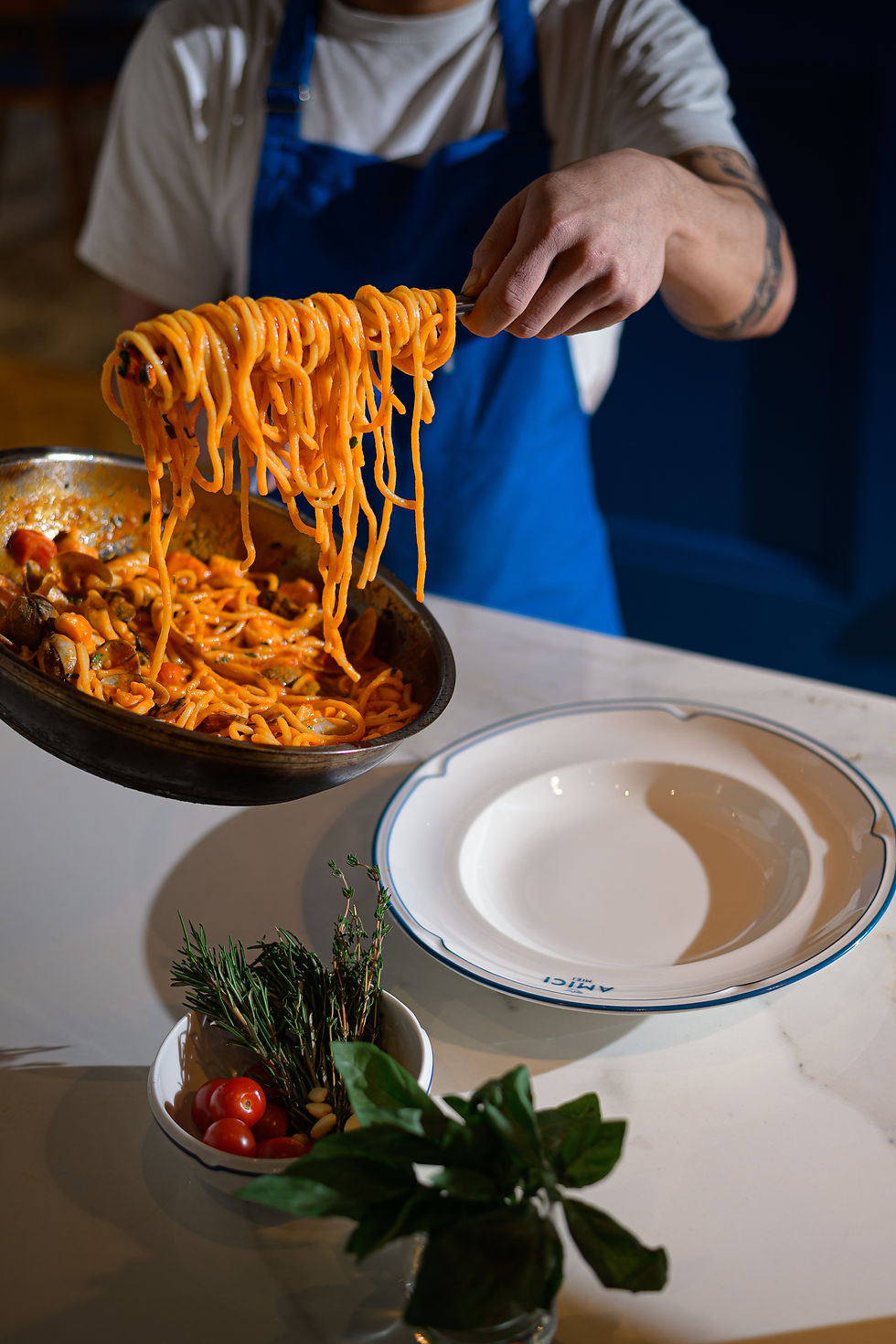
The word multisensory sounds academic. Let me make it practical.
When you look at a photograph of a perfectly plated dish on a white background, your brain processes it as information. You register that the dish exists, that it looks a certain way, that it might taste a certain way. But nothing fires. Nothing makes you lean forward or reach for your phone to find out where this restaurant is.
Now think about a three-second video clip of that same dish. The knife goes through a crispy piece of chicken and the sound, even imagined, of that crunch fires something in your brain before any conscious thought happens. Or steam rises off a bowl of soup and suddenly you feel warmth. Or someone takes a bite of a cookie and has to open their mouth wide because it's that thick, that generous, and you feel the size of it without touching anything.
63% of consumers say they actively crave multisensory brand experiences. 72% seek content that stimulates more than one sense at once. This is not a niche preference. It is the dominant direction of how people want to engage with food content in 2026.
The neuroscience behind this is straightforward: sight, sound, texture, smell, and atmosphere all influence how food is perceived and how strongly it's remembered. A photograph that makes you almost hear a crunch or almost smell smoke creates a stronger purchase intent than a flat beauty shot because more of your brain is involved in processing it. The technical term is cross-modal sensory transfer. The practical term is: it makes people hungry in a way that regular photos don't.
For a restaurant, multisensory content means a few specific things. It means motion, short video clips showing the moment of a pour, a slice, a pull, a bite. It means process, showing how the food is made, not just what it looks like finished. It means presence, hands in the frame, people eating, the environment of the restaurant visible and alive rather than cropped out. And it means honesty, content that feels like it was made by a human who cares about what they're showing, not assembled by an algorithm trying to hit visual benchmarks.
Two Shoots That Show What This Looks Like in Practice
The Cookie That Made People Open Their Mouths

I worked with a cookie brand over a period of time where the brief evolved significantly. Early on, the content was what most food brands produce: the cookie on a nice surface, good light, clean composition. It looked professional. It also looked like every other cookie brand's content.
The shift happened when we started shooting the cookie being eaten. Not styled eating, where someone holds food near their mouth and smiles. Actually eaten, with people taking real bites. And what became immediately visible was the size of the bite required. This was a thick, generous, serious cookie. To eat it properly you had to commit. You had to open your mouth wide, take a real bite, get involved.
That detail, the size of the bite, communicated something no beauty shot could. It communicated confidence. It said: we are not apologetic about how big and good this cookie is. We made it this way on purpose and we want you to experience it exactly like this.
People watching that content felt the texture before they ever tasted it. They felt the give of the cookie, the density of it, the satisfaction of a bite that actually requires something from you. And they ordered. Not because the cookie looked pretty. Because it felt worth eating.
Indian Rice, Egyptian Dish, and What Steam Can Say
A rice brand I worked with had a more complex story to tell. The rice itself was Indian in origin, aged and high quality. But the brand's ambition was to show that this rice was universal. That it could carry an Egyptian recipe as naturally as it carried a Filipino one, an Arabic one, any cuisine from any part of the world that the UAE contains.
We made a video. The dish we shot was Egyptian in preparation, but the rice was doing what great rice does: absorbing the flavors around it, carrying them, becoming part of the dish completely. And what you could see in the video, if you looked closely at the individual grains, at the steam rising, at the way the spices and the rice had come together, was that this rice belonged there. It wasn't a compromise or a substitution. It was the foundation.
The multisensory element was the steam and the texture of the individual grains visible in motion. Still photography could show you a beautiful rice dish. Video showed you the rice behaving, responding, performing. It made the brand's entire argument, that this rice is for everyone, without a single word of explanation.
That is what visual storytelling through sensory content can do that a photograph cannot. It shows a process, a behaviour, a truth about the product that only becomes visible when you see it in motion.
Why Polished Static Images Are Losing on Instagram Right Now
I want to be precise about this because I don't want restaurant owners to take the wrong lesson.
The problem is not that your food photography is too good. The problem is when it's too complete. When the image gives the viewer nothing to do, no question to ask, no sensation to imagine, no reason to stop scrolling and feel something.
Audiences in 2026 have developed a very fast filter for what they call ads. Content that looks like it was produced to sell something rather than to share something gets identified and dismissed in under a second. And overly polished, perfectly symmetrical, museum-piece food photography reads as an ad even when it technically isn't one. It triggers the scroll reflex before the viewer has consciously registered what they saw.
What stops the scroll is specificity. A half-eaten plate that shows someone actually enjoyed the food. A behind the scenes clip of the kitchen at 6am before service. A chef's hands doing something skilled and quick. An imperfect moment that looks genuinely real because it was.
Instagram and TikTok are actively prioritising motion-led content in their algorithms in 2026. This is not a secret. Both platforms have been transparent about the fact that video and reels receive significantly more distribution than static images. If your restaurant's content strategy is primarily static photography, you are working against the platform's own incentive structure every time you post.
This does not mean stop shooting stills. Your Deliveroo listing, your menu, your website, your press kit, all of these need strong static photography and always will. But your social media content strategy needs video and motion as the lead, with stills in a supporting role. That ratio has flipped from what it was three or four years ago, and the restaurants that haven't adjusted it yet are the ones wondering why their engagement has dropped.
The Question I Ask Every Restaurant Owner Who Is Sceptical
Occasionally a restaurant owner will push back on this. They understand the delivery platform photography, they get the menu shoot, but video and behind the scenes content feels like too much. Too complicated. Not their style.
When this happens I don't argue with data. I ask them a question.
Think about your customer. Not a general customer, a specific one. Picture them at a particular moment in their day. Maybe they're in an office at 1pm, slightly restless, not quite ready to decide where to order lunch from. Maybe they're on the couch at 9pm, phone in hand, thinking about dinner. Maybe they're standing in a mall deciding between three restaurants in the same food court.
Now: what would make that person, at that specific moment, choose you?
When restaurant owners actually sit with that question, the answer almost never involves a perfectly lit static photograph. It involves a feeling. A memory of a taste, or the creation of a new craving, or a sense of trust because they saw the kitchen and it looked clean and the chef looked like they cared. It involves something that made them feel like they already knew what the experience was going to be like before they committed to it.
That is what multisensory content does. It answers the question your customer is actually asking, which is not 'what does this dish look like?' but 'will I be glad I chose this?'
If they have already arrived at your menu, you have already sold them. But online, before they get there, you have to invite them in. And an invitation has to make someone feel something. A photograph of a dish on a white background is not an invitation. It is a catalogue entry.
What This Looks Like on Set in 2026
The practical difference between a shoot in 2022 and a shoot in 2026 is visible from the moment I arrive.
In 2022, a typical restaurant shoot was primarily stills. We'd plan the shots, style the dishes, get the lighting right, and work through a shot list. Video was an add-on if the client asked for it specifically.
Now video is built into the brief from the start. A shoot in 2026 typically involves planning both the static images and the motion content simultaneously, because the best motion moments often come from the same setup as the best still moments and you need to be ready to capture both. A sauce pour. A cheese pull. Steam rising off a hot dish right after it comes out of the kitchen. The first cut into a layered dessert. These are three to five second clips that, edited well, do more work on Instagram in a week than a static image does in a month.
Behind the scenes content has also become a genuine deliverable rather than an afterthought. Showing the kitchen at work, the prep process, the care that goes into something before it reaches the plate, this is trust-building content. It shows the customer what they cannot see when they order. And in a market where trust is built primarily through screens rather than in person, that visibility is valuable.
70% of creative agencies predict AI will be core to their workflow by the end of 2026. But the same research consistently shows that AI is being integrated as a tool for efficiency and testing, not as a replacement for the human creative decisions that make content feel real. The direction of the industry is more human, not less. More specific, more vulnerable, more honest. AI handles the repetitive. Humans handle the feeling.
The Practical Checklist: What Multisensory Content Looks Like for Your Restaurant
If you're thinking about how to shift your content strategy, here's what to actually consider.
Short motion content alongside every major dish
Three to five second clips. No narration needed, no graphics required. Just the moment of a pour, a slice, a bite, a pull. These are the highest-performing format on Instagram and TikTok for food content right now and they cost almost nothing extra to capture during a properly planned shoot.
Process content from your kitchen
You don't need a full production. A 15-second clip of your chef doing something skilled, something that shows care and technique, builds more trust than most things you can say about your food. People want to see that real humans are making what they're ordering. Show them.
Presence in the frame
Hands. A partial face. Someone eating. The environment of the restaurant in the background. In 2026, food floating in a void on a white background signals the absence of human presence, which signals the absence of human care. Put people back in the frame.
Imperfect moments alongside perfect ones
A half-eaten plate. A slightly imperfect pour. A dish that looks like it was made by someone rather than assembled by a machine. These images actually perform better than technically perfect ones because they feel true. They give the viewer permission to trust what they're seeing.
Content planned around your customer's actual moments
Where is your customer when they're most likely to see your content and be influenced by it? What time of day? What emotional state? Plan content that meets them there. Lunch content and dinner content and late-night content should not look or feel the same, because the customer at 1pm is not the same person they are at 10pm.
The Bigger Picture: What This Market Is Moving Toward
The UAE food market is growing at nearly 12% year on year. Dubai welcomed almost 20 million tourists in 2025. 70 to 82% of UAE residents use social media to find restaurants before making a reservation. This is one of the most food-obsessed, visually literate, content-saturated markets in the world.
In that environment, the ceiling for what 'good enough' looks like keeps rising. What impressed people in 2022 is baseline now. What stands out in 2026 is content that makes someone feel something specific and real, something that couldn't have been made by a prompt or assembled from stock imagery, something that carries the actual identity of your restaurant inside it.
That is the standard. And reaching it requires thinking about your visual content not as photography, not as video, but as an experience that starts on a screen and ends at your table.
The restaurants that understand this are not just getting more followers. They're getting more covers, more orders, more loyalty, more of the word of mouth that no advertising budget can buy. Because when someone feels something from your content, they talk about it. And in a city where everyone is looking for the next place to eat, that conversation is the most valuable thing you can generate.
If you want to talk about how to build a visual content strategy for your restaurant that goes beyond pretty pictures and actually moves your business forward, I'm always up for that conversation. Find me on Instagram at @ibrahim_food_photographer or see the full range of what we do at spinthirasmedia.com.


Comments