

Jewellery Photography Dubai: Why This Is the Most Technically Demanding Category in the UAE Market and How to Get It Right

Dubai is the gold capital of the world. Jewellery is produced here, made here, traded here, and moved through here in volumes few cities can match. The expertise in this city around gold itself is extraordinary, generations deep.
The expertise around photographing it is not. That is the strange gap in this market. Traders and jewellery owners who know everything there is to know about a stone or a setting often have no idea that photographing it is the hardest thing a commercial photographer can be asked to do. Not one of the hard things. The hardest.
Ibrahim Doodhwala has spent more than twelve years shooting commercial work across Dubai, and his position on this is unambiguous. Every other category of photography sits below jewellery in difficulty. Here is why, and what getting it right actually involves.
Jewellery Does Not Lie
Shreya: Make the case. Why is jewellery harder than every other category?
Ibrahim: Because jewellery does not lie. A jewellery piece has to look flawless, and the camera will not let it. A scratch smaller than a hair, and I mean genuinely smaller than a strand of hair, is visible in the final image. On a metal surface that tiny scratch reads like a deep scar on the side of a car. It is that obvious once it is on screen.
Shreya: Whereas with most products you have some margin.
Ibrahim: With most products you have enormous margin. A box has texture that hides things. Fabric hides things. Even a glass bottle forgives more than people think. Jewellery forgives nothing, because the entire promise of the object is perfection. The customer is paying for flawlessness, so the image has to deliver flawlessness, and every microscopic imperfection on that piece is working against you.
Every other category lets you photograph an object. Jewellery makes you photograph a promise, and the camera is looking for every reason to break it.
The Macro Lens Problem, and Why Focus Stacking Makes It Worse

Shreya: How does the technical setup make this harder rather than easier?
Ibrahim: Jewellery is generally shot with macro lenses, because you need that level of detail. But a macro lens at that magnification has extremely shallow focus. You cannot get the whole piece sharp in a single frame. It is physically not possible. The front of the stone is sharp and the back of the setting is already soft.
Shreya: So what do you do?
Ibrahim: Focus stacking. You shoot many frames, each one focused on a slightly different plane of the piece, and then combine them so the entire object is sharp from front to back. That is standard practice in high-end jewellery macro photography, and there is no way around it.
Shreya: And the catch?
Ibrahim: The catch is that focus stacking is a magnifying glass for problems. Every single detail is captured, across every frame. Every little scratch. Every unwanted reflection. Everything you would have got away with in a softer, single-frame image is now rendered in full sharpness across the entire piece. So the technique that solves your focus problem hands you a much bigger cleanliness and lighting problem in exchange. You are committing to absolute perfection whether you wanted to or not.
Every Piece Needs Its Own Lighting. Every Single One.
Shreya: With most product categories a photographer builds a setup and runs the collection through it. Does that work here?
Ibrahim: No, and this is the thing clients find hardest to believe. Forget having one setup for different shoots. You do not even get one setup for two pieces in the same shoot. Two rings from the same collection will not share a lighting position.
Shreya: Why does it break down that fast?
Ibrahim: Because everything depends on reflection, and reflection is unforgiving about angles. Where the light comes from, and where the piece sits in relation to it, is the whole game. Shift the placement of a diamond by ten degrees and the light has to move substantially to compensate. Ten degrees. That is nothing, that is a piece settling slightly differently on the surface, and your entire lighting design is now wrong.
Ibrahim: So you cannot put a flat, straight light on jewellery and work through the collection. Every piece is a fresh problem. That is why jewellery shoots take the time they take, and why anyone quoting you a per-piece rate as if it were catalogue work has not understood what they are agreeing to.
In most categories the photographer sets the light and the products come to it. In jewellery every piece sets its own light, and the photographer’s job is to find out what it demanded.
Making a Diamond Actually Look Like a Diamond
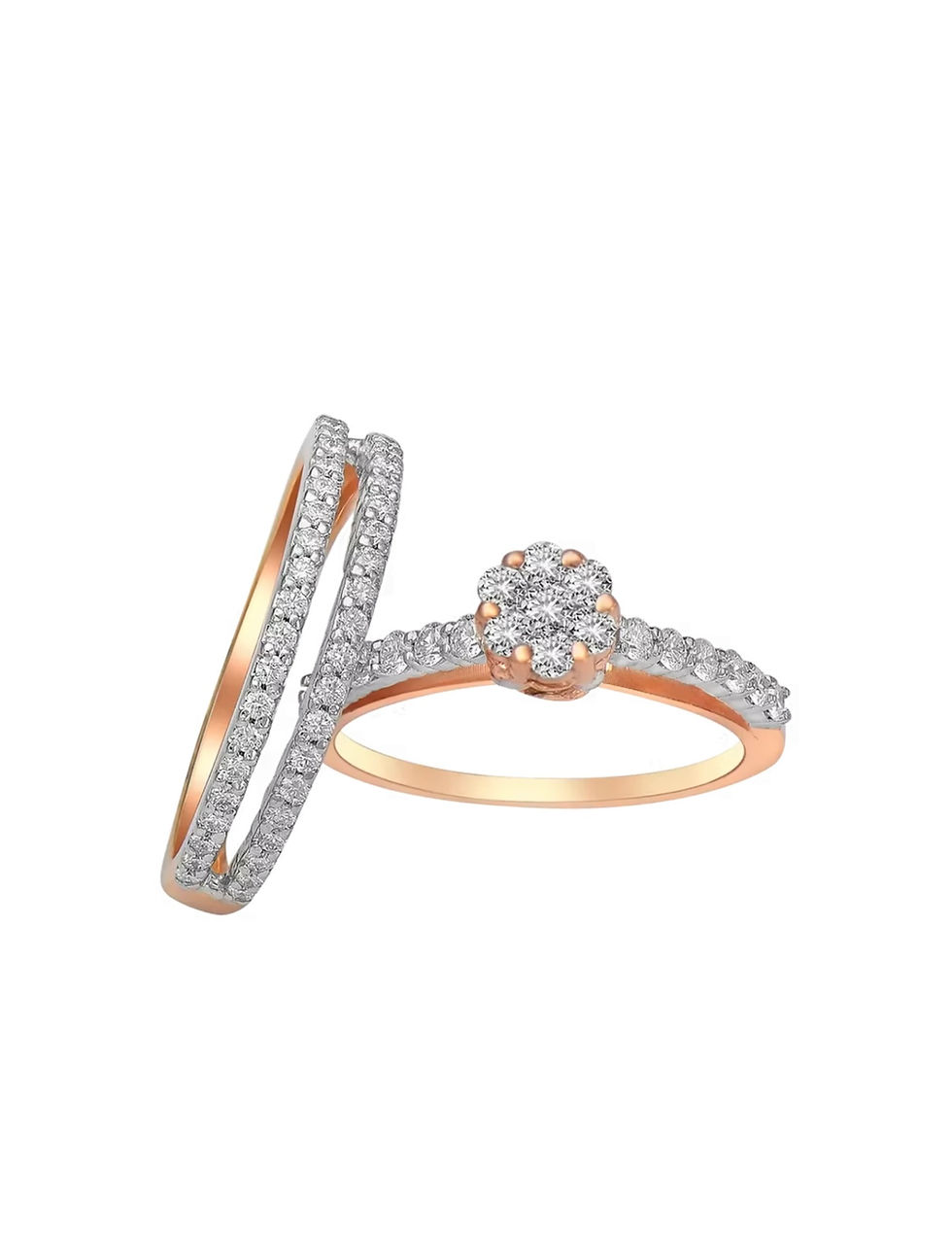
Shreya: What specifically makes stones so difficult?
Ibrahim: A diamond has two jobs in an image and they are different jobs. First, it has to reflect light back so it reads as a diamond at all. That part is achievable. But second, and this is the hard part, it needs a glow, a spark that appears to come from within the stone. Not light bouncing off the surface. Light that looks like it is alive inside the stone.
Shreya: How do you produce that?
Ibrahim: Entirely through the reflection. There is no filter for it and no retouching shortcut that looks real. The direction and quality of what the stone is reflecting is what creates that internal fire. So you are shaping the light until the stone stops looking like a shiny object and starts looking like it has something burning inside it. Get it wrong and you have photographed a piece of glass. The difference between those two images is the difference between a piece that sells and a piece that sits.
Yellow, Rose, White, Platinum, Diamond: All Similar, All Must Look Different
Shreya: Then there is colour. How big a problem is that?
Ibrahim: It is one of the biggest, and it is invisible to people until you point it out. Yellow gold, rose gold, white gold, platinum, and diamond all have to be separated from each other in the image. In reality several of these are quite similar in tone, especially white gold, platinum, and diamond, which can collapse into the same silvery colour very easily on camera.
Shreya: And presumably a client can tell instantly if they are wrong.
Ibrahim: Instantly, because they know exactly what they sold. A rose gold piece that photographs slightly too yellow is not a stylistic choice, it is a wrong product. So the photographer has to make sure every metal reads as distinctly itself, correctly separated from every other metal in the frame, and on top of that make sure the whole thing still looks good. Those two demands pull against each other constantly. Accuracy and beauty are not automatically the same picture, and in jewellery you are required to deliver both.
The Ring That Took Half a Day
Shreya: Give me one piece where this all came together.
Ibrahim: There was a ring, and calling it a ring undersells it. It was a full finger-length piece, with double ring holders, a large and elaborate object with several diamonds set into it. Genuinely a significant piece.
Shreya: How long did it take?
Ibrahim: Almost half a day for that single image.
Shreya: For one photograph.
Ibrahim: For one photograph. And I want people to understand why that is not excessive. When a piece is worth a great deal of money, the photographer’s responsibility is not just to show the diamonds correctly, the gold correctly, and the other gemstones correctly. All of that is the baseline. The real responsibility is that the image has to look worth the money. It has to carry the value of the object.
Ibrahim: A piece like that, with multiple stones at different angles across a large structure, means multiple reflection problems that all have to be solved simultaneously without cancelling each other out. You solve one stone and it changes what is happening on the next. That is where the hours go. Not to indulgence. To the fact that the object refuses to be simple.
A jewellery photograph does not just have to be accurate. It has to be worth the piece. If someone is spending serious money, the image must have already told them the piece deserves it.
What Makes Jewellery Photography Different
Challenge | Why it happens | What it demands |
Zero tolerance for flaws | A hair-thin scratch reads like a deep scar on metal | Meticulous cleaning and inspection before shooting |
Shallow focus | Macro lenses cannot hold a whole piece sharp | Focus stacking across many frames |
Amplified imperfections | Stacking renders every detail across the entire piece | Perfection in lighting and prep, not fixed later |
No repeatable setup | A ten-degree shift changes everything | Fresh lighting design for every single piece |
Diamond fire | Surface reflection alone looks like glass | Light shaped so the glow appears to come from within |
Metal separation | White gold, platinum, and diamond read alike | Accurate colour separation plus beauty, simultaneously |
Perceived value | The image must justify the price | Time, and a great deal of it |
What This Means If You Sell Jewellery in the UAE
Shreya: Does shooting for a traditional gold retailer differ from shooting for a modern jewellery brand?
Ibrahim: The technical problems are identical, because the metal and the stones do not care who owns them. What changes is what the image has to accomplish. A traditional retailer often needs accuracy above everything, because the buyer is evaluating the gold itself, the weight, the workmanship, the exact tone.
A newer brand selling online usually needs desire first, because the customer is buying a look before they are buying a material. Both still need the reflections solved correctly. But one image is arguing this is genuine and well made, and the other is arguing you want this on your hand. Knowing which argument you are making changes how the piece gets styled and lit, even though the underlying physics does not move.
Shreya: What should a jewellery brand or trader in this market take away?
Ibrahim: That the photography is not a line item to compress. In this city especially, where the product itself is world class, the image is often the only thing standing between your piece and someone else’s identical-looking piece. If your photography is generic, your gold looks generic, no matter how good it is in the hand.
Ibrahim: And understand what you are buying when you commission it. You are not buying a photographer’s time in the way you would for a catalogue. You are buying the solving of a fresh technical problem for every piece you own. When someone tells you a jewellery shoot moves slower than a product shoot, that is not inefficiency. That is what the category costs.
In a market this saturated with beautiful gold, the photograph is not a record of the piece. It is the argument for it.
If you sell jewellery in the UAE and your images are not carrying the value of what you actually make, that gap is costing you against competitors selling comparable pieces. This is the problem we solve. Reach Ibrahim on Instagram at @ibrahim_food_photographer, or see how we approach jewellery photography for UAE brands.


Comments